How Many mg of Cranberry PACs Do You Actually Need?
Quick Answer: How Many mg of Cranberry PACs Per Day?
At least 36 mg of proanthocyanidins per day — below that line a 2024 meta-analysis of 10 trials and 2,438 people found no statistically significant benefit at all, while at 36 mg or above the risk reduction was 18% (RR 0.82). Seventy-two milligrams is the only dose that still showed roughly half of its peak anti-adhesion activity 24 hours later in the dose-ranging trial — and that trial gave the whole amount as a single morning dose, so the popular advice to split 36 mg between morning and evening is a reasonable inference, not something anyone has actually tested.
- Threshold: 36 mg PAC/day. Under it, the pooled effect disappears.
- Duration of effect: 72 mg was the only dose still active at 24 hours.
- The catch: “cranberry extract 500 mg” is not a PAC figure, and most labels print nothing else.
Almost every article about cranberry repeats the same number: 36 mg of proanthocyanidins — a figure that does not appear in the NIH NCCIH consumer summary on cranberry at all. Very few explain where it came from, what happens on either side of it, or why the figure is impossible to check on most products sold today. This page is only about the amount. If you want the separate question of whether cranberry does anything at all, we covered the trial evidence in our review of cranberry and Lactobacillus for women's urinary health.
The 36 mg threshold, and the study that drew the line
The threshold is not a marketing round number. It comes out of a 2024 systematic review and meta-analysis in Frontiers in Nutrition by Xiong and colleagues, which pooled 10 randomised controlled trials covering 2,438 participants — 1,217 taking a cranberry product and 1,221 controls — and then split them by how much PAC the product actually delivered per day.
The split produced a clean break. Trials delivering at least 36 mg of PAC per day showed a statistically significant 18% reduction in risk. Trials delivering less than that showed nothing that reached significance. Same botanical, same outcome measure, different dose, opposite conclusion — which is a large part of why cranberry has looked so inconsistent in the literature for thirty years.
What the 2024 meta-analysis found, by subgroup
| Subgroup | Risk ratio | 95% CI | p | Significant? |
|---|---|---|---|---|
| PAC intake ≥36 mg/day | 0.82 | 0.69 – 0.98 | 0.03 | Yes — 18% lower risk |
| PAC intake <36 mg/day | — | — | 0.39 | No |
| Female-only cohorts | 0.84 | 0.71 – 0.98 | 0.02 | Yes |
| Mixed-gender cohorts | — | — | — | No |
| Use for 12 – 24 weeks | 0.75 | 0.61 – 0.91 | 0.004 | Yes |
| Use for under 12 weeks | — | — | — | No |
| Use for over 24 weeks | — | — | — | No |
Source: Xiong Z, Gao Y, Yuan C, Jian Z, Wei X. Frontiers in Nutrition 2024;11:1422121. PMID 39668896.
Two things in that table deserve more attention than they usually get. The mixed-gender row is a genuine null result and it is rarely quoted. And the duration rows show that dose alone is not the whole story — the pooled benefit only reached significance in the trials that ran for 12 to 24 weeks. A correctly dosed product taken for three weeks is not a tested scenario.
The dose-response data: 18 mg vs 36 mg vs 72 mg
The meta-analysis tells you where the line is. It does not tell you what happens across a day. For that you need the dose-ranging study everyone cites and almost nobody reproduces: Howell and colleagues, published in BMC Infectious Diseases in 2010.
The design matters, so here it is in full. Thirty-two female volunteers over the age of 18, sexually active, with normal renal function, were recruited through four urology departments — eight each in Japan, Hungary, Spain and France — for a randomised, double-blind, placebo-controlled cross-over study. The volunteers in Japan and Hungary received 0, 36 or 72 mg of PAC equivalents per day; those in Spain and France received 0, 18 or 36 mg. Everyone took two capsules at 8:00 AM. Urine was pooled from 9:00 AM to 2:00 PM (the “1–6 h” sample) and again the following morning (the “24 h” sample). Anti-adhesion activity was measured with a mannose-resistant haemagglutination assay against uropathogenic E. coli.
Anti-adhesion activity in urine, by PAC dose
| PAC dose (single morning dose) | Anti-adhesion activity at 1–6 h (median) | at 24 h (median) | Study | n receiving this arm |
|---|---|---|---|---|
| Placebo (0 mg) | 0% | 0% | Howell 2010 | 32 |
| 18 mg PAC | 50% | 0% | Howell 2010 | 16 (Spain, France) |
| 36 mg PAC | 90.6% | 12.5% | Howell 2010 | 32 (all four sites) |
| 72 mg PAC | 100% | 50% | Howell 2010 | 16 (Japan, Hungary) |
Source: Howell AB, Botto H, Combescure C, et al. BMC Infectious Diseases 2010;10:94. PMID 20398248. Values are pooled medians from the mannose-resistant haemagglutination assay.
The statistics behind those medians are worth stating precisely. At 6 hours, 18 mg differed significantly from both 36 mg and 72 mg (p = 0.002), but 36 mg and 72 mg did not differ from each other. At 24 hours the picture inverted: the 72 mg arm still showed 50% anti-adhesion activity, against 12% for 36 mg and 0% for 18 mg (p = 0.002). The authors concluded that cranberry powder standardised to 72 mg of PAC per day “may offer some protection against bacterial adhesion and virulence in the urinary tract”, and described the effect as potentially nyctohemeral — covering the full day and night.
Note what this does not establish. Nobody in this trial took 36 mg twice a day. The 72 mg arm swallowed 72 mg in one go at breakfast. Splitting the dose is a sensible-sounding way to chase the same 24-hour coverage, and it is what several practitioners suggest, but it is an extrapolation from a single-dose experiment rather than a tested regimen. We would rather say that plainly than let a comparison table imply an evidence base that is not there.
Why “cranberry extract 500 mg” tells you nothing
Here is the practical problem. The number on the front of most cranberry products is an extract weight, and an extract weight has no fixed relationship to PAC content. The same arithmetic applied to drinks is in our piece on cranberry supplement versus juice. Two capsules both honestly labelled “cranberry extract 500 mg” can differ by an order of magnitude in the compound the research is actually about, for three separate reasons.
The extraction ratio. A 50:1 extract and a 4:1 extract are both extracts. They concentrate the source fruit to very different degrees, and unless the label states a drug-to-extract ratio you cannot tell which you are holding.
Standardisation, or its absence. A standardised product is manufactured to hit a stated percentage of a named marker compound. An unstandardised one is not. If no percentage and no marker appear on the panel, the PAC content is whatever that batch of fruit happened to contain.
The assay. PAC content is a measured value, and the measurement method changes the number. In the Howell trial, the PACs were quantified by Brunswick Laboratories using an updated dimethylaminocinnamaldehyde (DMAC) colorimetric method, run after open-column gel chromatography on Sephadex LH-20. That is a specific, documented procedure. A milligram figure produced by a different method is not automatically interchangeable with it. We looked for a published inter-assay variance figure we could quote here and could not verify one to our own standard, so we are not going to invent a percentage — the honest version is simply that the method matters and almost no consumer label names one.
There is a fourth wrinkle, less widely known: not all proanthocyanidins in a cranberry product are equally available. A 2021 paper in the Journal of Dietary Supplements compared urinary bacterial anti-adhesion activity after cranberry supplements containing soluble versus insoluble proanthocyanidins, and reported that the two forms did not behave the same way. We have not been able to verify that paper's author list and effect sizes against PubMed to the standard we apply to numbers on this site, so we cite it as a direction of travel rather than quoting figures from it: a milligram of “cranberry” is not automatically a milligram of usable PAC.
What your label does not tell you
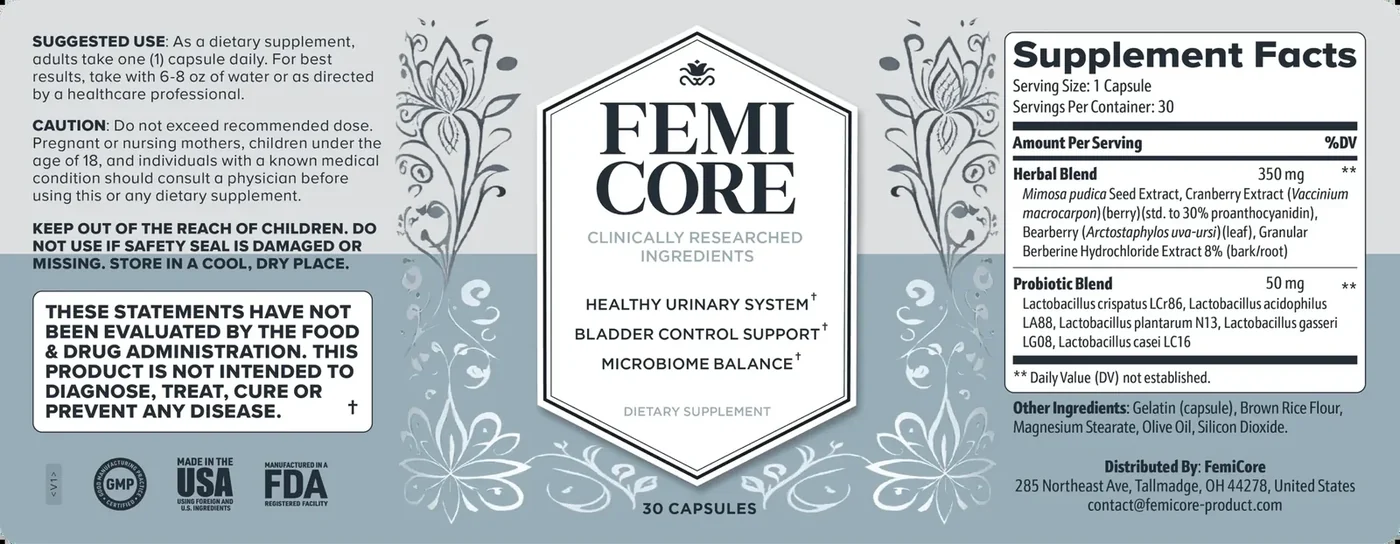
We apply this to the product this site covers, because it would be dishonest not to. FemiCore does not publish a PAC milligram figure anywhere. We read this site's own ingredient breakdown and the manufacturer's sales-page text directly. Nine ingredients are named — cranberry extract, bearberry leaf, berberine, mimosa pudica seed and five Lactobacillus species — and not one milligram amount, standardisation percentage or CFU count appears for any of them. The manufacturer's own FAQ describes it as a proprietary formula.
That is not an accusation of anything; plenty of multi-ingredient supplements are sold this way. But it has a concrete consequence for the question this page is about: the 36 mg threshold cannot be checked against FemiCore, or against any other product that prints only ingredient names. A buyer who wants to know whether they are above or below the line that the research draws simply cannot find out.
If you want the full ingredient-by-ingredient picture including where we think the evidence is weakest, that is on our main FemiCore review. And if you are looking at a formula that also contains bearberry, read the duration limit regulators place on uva-ursi before you commit to a six-month supply — it is a separate issue from dose and it catches people out.
See the current FemiCore pricing and guarantee
Orders are handled on the manufacturer's official checkout, with the 60-day money-back guarantee attached. Doses are not disclosed on the label — we would rather you knew that before you buy than after.
Order NowHow to actually reach 36 mg
Four checks, in the order they are worth doing.
1. Find a PAC number, not an extract number. The panel should read something like “proanthocyanidins (PACs) 36 mg”. If it reads “cranberry fruit extract 500 mg” and stops, the product is unverifiable against the research, however good it may be.
2. Look for a named method. Better labels state how the PAC figure was measured. Most do not. A stated method is a signal that somebody measured rather than estimated.
3. Decide about 72 mg deliberately. Thirty-six milligrams is the threshold the pooled clinical data supports. Seventy-two milligrams is what carried measurable activity through to the next morning in the single dose-ranging trial. Those are two different claims resting on two different kinds of evidence, and it is worth knowing which one you are buying.
4. Plan for months, not weeks. The only duration band that reached significance in the 2024 pooled analysis was 12 to 24 weeks. A two-week trial of a cranberry product is not a test of anything.
What the evidence does not show
Being straight about the limits is the whole point of a dose article, so here they are.
Anti-adhesion activity is a surrogate, not an outcome. The Howell table above measures how well bacteria stick in a laboratory assay using a volunteer's urine. It does not count infections. A dose that wins on a surrogate marker has not thereby been shown to change how anyone feels.
The dose-ranging trial was small and short. Thirty-two healthy volunteers, a single morning dose, two urine collections. It was designed to compare doses, and it does that well. It was never designed to establish clinical benefit, and it did not.
The meta-analysis carries its authors' own caveats. Xiong and colleagues explicitly flag the limited quantity and quality of the available randomised trials, participant dropout that reduced statistical power, inconsistent criteria for what counted as an infection across the included studies, and follow-up capped at one year. An 18% relative reduction pooled from that evidence base is a real signal, not a settled fact.
The effect is not universal. The mixed-gender subgroup showed nothing. Neither did the sub-36 mg trials, whatever else was in them.
No dose is a treatment. None of this concerns an active infection. Cranberry proanthocyanidins are studied as a preventive support measure in people prone to repeat episodes. If you have symptoms — burning, urgency, fever, pelvic or flank pain, or blood in the urine — that is a medical situation and a clinician is the answer, not a capsule.
And no finished product has been trialled. Ingredient evidence is not product evidence. There is no published clinical trial of FemiCore itself, and there is no PAC figure on its label to connect it to the trials of the ingredient. The same gap runs through most of the category, which is why our overview of urinary support supplements for women ranks ingredients rather than brands.
Medical note: this article is general information, not medical advice. FemiCore is a dietary supplement, not a drug, and is not intended to diagnose, treat, cure or prevent any disease. Speak to a healthcare professional before starting any supplement, especially if you are pregnant, nursing, under 18, or taking medication.
Frequently asked questions
How many mg of cranberry PACs should I take per day?
At least 36 mg a day. In a 2024 meta-analysis of 10 randomised trials and 2,438 participants, a daily intake of 36 mg or more of proanthocyanidins was associated with an 18 percent lower risk of urinary tract infection (RR 0.82, 95% CI 0.69 to 0.98, p = 0.03), while intakes below 36 mg showed no statistically significant reduction at all (p = 0.39).
Is 72 mg of cranberry PAC better than 36 mg?
It lasted longer in the one trial that compared them head to head. In a 2010 dose-ranging study of 32 women, 36 mg and 72 mg produced similar anti-adhesion activity in urine 6 hours after a single morning dose, with no significant difference between them. By 24 hours only the 72 mg dose still showed about 50 percent activity, against 12 percent for 36 mg and 0 percent for 18 mg. That is a laboratory measurement in urine, not a count of infections.
Does cranberry extract 500 mg mean 500 mg of PACs?
No. Extract weight and proanthocyanidin content are two different numbers. A 500 mg cranberry extract can contain almost any amount of PAC depending on the raw material, the extraction ratio, and whether the product is standardised at all. If a label prints only a total extract weight, there is no way to compare it to the 36 mg threshold used in the research.
Does FemiCore state how many mg of PACs it contains?
No. The supplement facts panel standardises its cranberry extract to 30 percent proanthocyanidin, which is more than most formulas disclose, but it prints only a 350 mg total for the whole herbal blend and no separate weight for the cranberry inside it. Without that weight the 30 percent has nothing to multiply, so the 36 mg threshold still cannot be checked against this product, and we are not going to pretend otherwise.
Does a higher PAC dose work for everyone?
No. In the same 2024 meta-analysis the reduction in risk reached statistical significance in the subgroups made up only of women (RR 0.84, 95% CI 0.71 to 0.98, p = 0.02), but not in mixed-gender groups. Cranberry is also not a treatment for an active infection at any dose. If you have symptoms, see a clinician.
Scientific references
- Howell AB, Botto H, Combescure C, et al. — Dosage effect on uropathogenic Escherichia coli anti-adhesion activity in urine following consumption of cranberry powder standardized for proanthocyanidin content: a multicentric randomized double-blind study, BMC Infectious Diseases 2010;10:94 (PMID 20398248)
- Howell et al. 2010 — full text, DOI 10.1186/1471-2334-10-94
- Xiong Z, Gao Y, Yuan C, Jian Z, Wei X. — Preventive effect of cranberries with high dose of proanthocyanidins on urinary tract infections: a meta-analysis and systematic review, Frontiers in Nutrition 2024;11:1422121 (PMID 39668896)
- Xiong et al. 2024 — full text, DOI 10.3389/fnut.2024.1422121
- Differences in Urinary Bacterial Anti-Adhesion Activity after Intake of Cranberry Dietary Supplements with Soluble versus Insoluble Proanthocyanidins, Journal of Dietary Supplements (2021), DOI 10.1080/19390211.2021.1908480
- NIH NCCIH — Cranberry: What You Need To Know
Order FemiCore from the official store
Cranberry, bearberry and five Lactobacillus strains in one daily capsule, with the 60-day money-back guarantee handled by the manufacturer.
Order Now