Urinary Support Supplements for Women: What the Evidence Says
Quick Answer: What Is Urinary Support for Women?
Urinary support for women means nutrition aimed at keeping a healthy urinary tract comfortable — not treatment for an infection, urgency or leaking. Only one ingredient class has strong randomised evidence in women: cranberry proanthocyanidins, and only at roughly 36 mg of PAC a day or more. Everything else in the category is weaker, and nothing in it has been shown to reduce urinary urgency or incontinence.
- Best evidence: cranberry PACs, then hydration; both reduced repeat infections in randomised trials.
- Weaker than its reputation: D-mannose, which failed its largest randomised trial in 2024.
- Different problem: urgency and leaking respond to pelvic floor training, not to supplements.
“Urinary support for women” is a shelf, not a science. Cranberry capsules, D-mannose powders, probiotic blends and uva-ursi extracts all carry roughly the same marketing; the evidence behind them differs enormously. This guide sorts the category by what has been tested in women, names the doses the trials used, and is equally clear about the questions the research has never asked.
What does “urinary support” actually mean on a label?
Urinary support is a regulatory description, not a medical one. In the United States, a dietary supplement may make structure/function claims — that it “supports a healthy urinary tract” or “supports bladder control” — provided it carries the disclaimer that the statement has not been evaluated by the Food and Drug Administration and that the product is not intended to diagnose, treat, cure or prevent any disease. That sentence is doing real work. It is the difference between a nutrition product and a medicine, and it is why no honest urinary supplement page can tell you a capsule will clear an infection or stop a leak.
What sits inside the category is fairly consistent: a cranberry extract, sometimes standardised to a stated percentage of proanthocyanidins; D-mannose; one or more Lactobacillus strains; and a traditional urinary herb, usually bearberry (uva-ursi). Combination products add several at once, which makes them harder rather than easier to evaluate, because the panel often prints one total for a blend instead of the amount of each ingredient. We work through how to unpick that in our women’s microbiome supplement label audit.
Female bladder health and a urinary tract infection are two different problems
A urinary tract infection is bacterial colonisation of the bladder or urethra, usually by E. coli, and it is diagnosed and treated medically. Bladder health, in the sense most women mean it, is about function and comfort: how often you need to go, how urgently, whether you can wait, and whether anything leaks. Those are separate problems with separate causes, and the entire supplement category has been tested against only the first one.
That distinction matters commercially: urinary products are often sold with imagery about not reaching a bathroom in time — a bladder-function promise — while citing research about infection recurrence. Those are not the same endpoint.
What causes urinary urgency in women?
Urinary urgency is the sudden, hard-to-defer need to pass urine, and when it is persistent it is usually classified as overactive bladder rather than as an infection. It is not rare. The EPIC study, a population survey of 19,165 adults across five countries, put the overall prevalence of overactive bladder at 11.8 per cent, with storage symptoms reported by 59.2 per cent of women and rates rising with age.
The common drivers are structural and neurological rather than nutritional: pelvic floor weakness after childbirth, the tissue changes of menopause, bladder irritants, some medications, constipation and neurological conditions. An acute infection can also cause urgency, which is why new urgency is worth having checked rather than supplemented.
When urinary urgency needs a doctor rather than a supplement
Burning when you urinate, fever, blood in the urine, pain in the back or side, urgency that starts suddenly, or leaking that is affecting your day are all reasons to see a clinician. The NIH’s guidance on bladder control problems in women sets out the assessment involved, and it is not something a capsule substitutes for.
Which urinary support ingredients have evidence in women?
Here is the category ranked by the strength of randomised evidence in women, rather than by how often it appears in advertising.
| Ingredient | Best evidence in women | Outcome measured | Verdict |
|---|---|---|---|
| Cranberry PACs | Cochrane review, 50 trials | Recurrent UTI | Strongest in the category |
| Water intake | Randomised trial, 140 women | Recurrent cystitis | Strong, and free |
| Lactobacillus | Phase 2 trial, 100 women | Recurrent UTI | Promising, strain-specific |
| Bearberry (uva-ursi) | Randomised trial, 398 women | Acute UTI vs antibiotic | Short-course only |
| D-mannose | Randomised trial, 598 women | Recurrent UTI | Failed its largest trial |
| Any of the above | None | Urgency or leaking | Untested |
Cranberry proanthocyanidins: the strongest case, at a real dose
Cranberry is the only ingredient in the category with a large, current systematic review behind it. The 2023 Cochrane review by Williams and colleagues pooled 50 randomised trials and 8,857 participants and found that cranberry products reduced the risk of symptomatic, culture-verified urinary tract infections (risk ratio 0.70), with the effect holding in the subgroup of women with recurrent infections (8 trials, 1,555 women; risk ratio 0.74). Cochrane graded that as moderate-certainty evidence — a real finding, not a definitive one.
The dose is the part that gets lost. A 2024 meta-analysis in Frontiers in Nutrition by Xiong and colleagues found the preventive effect concentrated in trials using roughly 36 mg of proanthocyanidins a day or more. A product that lists “500 mg cranberry” without a PAC figure tells you nothing about whether it clears that line, which is why we wrote a whole piece on how many milligrams of cranberry PAC the trials actually used.
D-mannose: the popular one that failed its biggest test
D-mannose is a simple sugar thought to occupy the adhesion sites E. coli uses to grip the bladder wall, and for years it rode a wave of small, encouraging studies. Then it was tested properly. A 2024 randomised trial in JAMA Internal Medicine by Hayward and colleagues, in 598 women with recurrent urinary tract infections in UK primary care, found that daily D-mannose did not reduce the proportion of women with a further medically attended infection compared with placebo.
That is not proof it does nothing in any context, but it is the largest and best-designed trial the ingredient has, and it was negative. Anyone selling D-mannose as the evidence-based choice has the ranking backwards — the detail is in our comparison of D-mannose versus cranberry PACs.
Lactobacillus strains and the urinary microbiome
The rationale is sound: Ravel and colleagues’ 2011 survey of the vaginal microbiome established that most healthy reproductive-age women carry a community dominated by Lactobacillus species, travelling with a lower vaginal pH. The question is whether swallowing or inserting particular strains changes anything clinically.
The most instructive trial is Stapleton and colleagues’ placebo-controlled phase 2 study of an intravaginal L. crispatus product: recurrent infection occurred in 15 per cent of the probiotic group versus 27 per cent of the placebo group, a difference that did not reach statistical significance in a trial of that size, though women who achieved high-level colonisation did significantly better. Oral products face an extra hurdle, since the strain has to survive the gut and reach the urogenital tract at all — a question we follow through in do oral probiotics reach the vagina. It can happen: a 2025 randomised trial in Microbiology Spectrum detected an orally administered L. gasseri strain vaginally in most participants. Detection is not the same as benefit, and results belong to the specific strain code tested, never to the species as a whole.
Bearberry (uva-ursi): a short-course herb, not a daily one
Bearberry has the longest traditional record in the category and the tightest limits on use. A 2021 randomised trial by Gágyor and colleagues compared uva-ursi extract with the antibiotic fosfomycin as initial treatment in 398 women with uncomplicated urinary tract infections: the herbal arm cut antibiotic use by 63.6 per cent, but carried a higher total symptom burden and more cases of pyelonephritis, and it failed to show non-inferiority. European herbal monographs restrict uva-ursi to short courses of about a week and a few episodes a year, which is why a continuous daily bearberry habit is the wrong shape for the ingredient — the reasoning is in our piece on the bearberry duration limit.
Water: the intervention that outperformed most of the shelf
The cheapest option in urinary support has one of the better trials. Hooton and colleagues, in JAMA Internal Medicine in 2018, asked 140 premenopausal women with recurrent cystitis who drank under 1.5 litres a day to add 1.5 litres of water daily; over 12 months their average number of infections fell from about 3.2 to 1.7, with fewer antibiotic courses. The catch is that everyone enrolled was under-hydrated at baseline, so the finding is about correcting a deficit rather than about drinking endlessly — the nuance is in how much water is actually enough.
What the evidence shows — and what it does not
Being precise about the boundary is the most useful thing this page can do.
- Shown: cranberry products reduce recurrent urinary tract infections in susceptible women, at PAC doses around 36 mg a day or higher.
- Shown: correcting low fluid intake reduces recurrent cystitis in women who were drinking too little.
- Suggested, not established: particular Lactobacillus strains may reduce recurrence when they colonise; the trials are small and strain-specific.
- Not shown: that D-mannose prevents recurrent infection, in the largest trial run so far.
- Never tested: that any of these ingredients reduces urinary urgency, frequency, or stress or urgency incontinence.
- Never claimable: that a supplement treats an active infection. That is an antibiotic decision made by a clinician.
One further limit applies to combination products, which is most of this category: a trial of cranberry at a stated PAC dose is evidence about that dose, not about a proprietary blend that may contain a fraction of it. Ingredient evidence is not product evidence, and the gap between the two is where most of the marketing lives.
For leaking and urgency, the evidence points somewhere else entirely
If the problem you actually want solved is urgency or leaking, the intervention with the numbers is not on the supplement shelf. A 2018 Cochrane review of pelvic floor muscle training by Dumoulin and colleagues, covering 31 trials and 1,817 women from 14 countries, found that women with stress urinary incontinence who trained were around eight times more likely to report cure than women given no treatment (56 per cent versus 6 per cent), which Cochrane graded as high-quality evidence.
No supplement in this category has anything approaching that. If leaking is the issue, pelvic floor training — ideally taught by a physiotherapist — is where the effort belongs.
How to choose a women’s urinary support supplement
If a supplement is worth trying alongside the basics, these checks separate a readable label from a vague one.
- Find the PAC milligrams, not the cranberry milligrams. Only a stated proanthocyanidin figure — or a percentage you can multiply out — tells you whether the product reaches the studied dose.
- Look for strain codes. “L. crispatus” is a species; “L. crispatus LCr86” is a strain, and trials belong to strains.
- Treat proprietary blends as missing information. One total printed for four ingredients means you cannot verify any of them.
- Check the CFU statement, and ignore the size of the number. What matters is whether the count is guaranteed at expiry rather than at manufacture — see why a bigger CFU count is not a better product.
- Check bearberry duration. If uva-ursi sits in a product designed for continuous daily use, that conflicts with how the herb is meant to be taken.
- Check interactions. Berberine, a common addition to women’s formulas, inhibits drug-metabolising enzymes and is worth clearing with a pharmacist if you take anything regularly.
- Give it 12 weeks, and keep the receipt. The trials that found benefit ran for months. A three-week trial answers nothing.
Common mistakes with urinary support supplements
Four patterns come up repeatedly, and all four are avoidable. Buying on total milligrams. A large cranberry number with no PAC figure can deliver less active compound than a smaller standardised extract. Expecting treatment. Prevention research does not transfer to an active infection, and delaying care is how a bladder infection becomes a kidney one. Judging in days. Both literatures work in weeks to months. Ignoring the free variables. Fluid intake, voiding habits and pelvic floor strength are better evidenced than most of the shelf and cost nothing. If your urinary picture is really a vaginal one, the route is different again — see normal vaginal pH and home testing and cranberry and Lactobacillus together.
Medical note: this article is general information, not medical advice. No dietary supplement diagnoses, treats, cures or prevents urinary tract infections, incontinence or overactive bladder. Seek prompt care for burning, fever, blood in the urine, or back or side pain, and speak to a clinician about persistent urgency or leaking.
Related reading
- Cranberry PAC Dose: How Many mg?
- D-Mannose vs Cranberry PACs: The Evidence
- Water Intake and Urinary Health: How Much Is Enough
Frequently asked questions
What is a urinary support supplement for women?
A urinary support supplement for women is a dietary supplement, not a medicine, that combines ingredients associated with urinary comfort and bladder wellness — most often cranberry proanthocyanidins, D-mannose, Lactobacillus strains, and traditional urinary herbs such as bearberry. These products are sold to support a healthy urinary tract in generally healthy women; they are not licensed to diagnose, treat, cure or prevent urinary tract infections, incontinence or overactive bladder. The regulated claim language on the label reflects that: it describes support for structure and function, not treatment.
Which urinary support ingredient has the strongest evidence in women?
Cranberry has the strongest evidence. A 2023 Cochrane review of 50 randomised trials and 8,857 participants found cranberry products reduced the risk of symptomatic, culture-verified urinary tract infections overall, and in the subgroup of women with recurrent infections specifically. A 2024 meta-analysis narrowed that further: the benefit appeared at roughly 36 mg of proanthocyanidins a day or more, and low-dose products did not show it. So the useful question is not whether a bottle says cranberry, but how many milligrams of proanthocyanidins a daily serving actually delivers.
Do urinary supplements help with urinary urgency or leaking?
There is no good trial evidence that any supplement reduces urinary urgency, urgency incontinence or stress incontinence. The trials behind cranberry, D-mannose and Lactobacillus all measured infection recurrence, not urgency or leaking, and results from one outcome do not transfer to another. What does have strong evidence for leaking is pelvic floor muscle training: a 2018 Cochrane review of 31 trials in 1,817 women found women with stress incontinence who trained were about eight times more likely to report cure than untreated controls. If urgency or leaking is the problem, that is the intervention with the numbers behind it.
How do I choose a women's urinary support supplement?
Read the panel rather than the front label. Check the proanthocyanidin milligrams rather than the milligrams of cranberry powder, look for strain codes rather than bare species names, and be wary of proprietary blends that print a single total for several ingredients because they hide the individual doses. Check that bearberry, if present, is intended for short courses rather than continuous use, and check for interactions if you take prescription medication. Finally, judge the product over 12 weeks, since the trials that found benefits ran over months, not days.
Scientific references
- Williams G, Stothart CI, Hahn D, et al. — Cranberries for preventing urinary tract infections, Cochrane Database of Systematic Reviews 2023;11:CD001321 (PMID 37947276)
- Xiong Z, Gao Y, Yuan C, Jian Z, Wei X — Preventive effect of cranberries with high dose of proanthocyanidins on urinary tract infections: a meta-analysis and systematic review, Frontiers in Nutrition 2024 (PMID 39668896)
- Hayward G, Mort S, Hay AD, et al. — d-Mannose for Prevention of Recurrent Urinary Tract Infection Among Women: A Randomized Clinical Trial, JAMA Internal Medicine 2024;184(6):619–628 (PMID 38587819)
- Stapleton AE, Au-Yeung M, Hooton TM, et al. — Randomized, placebo-controlled phase 2 trial of a Lactobacillus crispatus probiotic given intravaginally for prevention of recurrent urinary tract infection, Clinical Infectious Diseases 2011;52(10):1212–1217 (PMID 21498386)
- Gágyor I, Hummers E, Schmiemann G, et al. — Herbal treatment with uva ursi extract versus fosfomycin in women with uncomplicated urinary tract infection in primary care: a randomized controlled trial, Clinical Microbiology and Infection 2021;27(10):1441–1447 (PMID 34111592)
- Hooton TM, Vecchio M, Iroz A, et al. — Effect of Increased Daily Water Intake in Premenopausal Women With Recurrent Urinary Tract Infections: A Randomized Clinical Trial, JAMA Internal Medicine 2018;178(11):1509–1515 (PMID 30285042)
- Dumoulin C, Cacciari LP, Hay-Smith EJC — Pelvic floor muscle training versus no treatment, or inactive control treatments, for urinary incontinence in women, Cochrane Database of Systematic Reviews 2018;10:CD005654 (PMID 30288727)
- Irwin DE, Milsom I, Hunskaar S, et al. — Population-based survey of urinary incontinence, overactive bladder, and other lower urinary tract symptoms in five countries: results of the EPIC study, European Urology 2006;50(6):1306–1315 (PMID 17049716)
- Ravel J, Gajer P, Abdo Z, et al. — Vaginal microbiome of reproductive-age women, Proceedings of the National Academy of Sciences 2011;108(Suppl 1):4680–4687 (PMID 20534435)
- NIH NIDDK — Bladder Control Problems in Women: causes, assessment and treatment
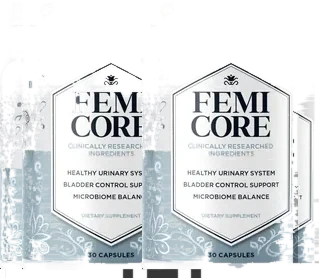
One capsule, four botanicals and five Lactobacillus strains
FemiCore is one product in this category: a daily capsule pairing cranberry, bearberry, berberine and mimosa pudica with a five-strain Lactobacillus blend, sold with a 60-day money-back guarantee handled by the manufacturer. Like every supplement discussed above, it is preventive nutrition rather than a treatment for an infection, urgency or incontinence.
Order Now