Probiotic CFU Counts: Why More Isn't Always Better
Quick Answer: Does a Higher CFU Count Mean a Better Probiotic?
No. CFU counts the live bacteria in a dose — a quantity, not a quality. Benefit in the research is tied to a specific strain at the dose actually studied, often 1–10 billion CFU, not the 50 or 100 billion on premium labels. Strain identity and viability through shelf life decide far more than the headline number.
- What CFU is: live, divide-able cells per dose — not effectiveness.
- The real levers: the exact strain, and whether the count holds at expiry.
- Marketing tell: a giant CFU number with no strain codes and no expiry guarantee.
Walk down the probiotic aisle and the numbers escalate like a bidding war: 10 billion, 50 billion, 100 billion, and somewhere a bottle shouting 500 billion. The unstated promise is that bigger is stronger. It is one of the most durable myths in the supplement category, and it survives because the number sounds scientific and nobody explains what it measures. This article is about that one number — what a CFU count actually is, what it cannot tell you, and the two things on the label that matter more.
What a CFU count actually measures
CFU stands for colony-forming units. When a lab wants to know how many live bacteria are in a sample, it dilutes the sample, spreads it on a nutrient plate, and counts the visible colonies that grow. Each colony is assumed to have started from one viable cell, so the count is reported as colony-forming units. The key word is viable: CFU counts only the cells that are alive and able to divide. Dead cells, and cells too damaged to reproduce, do not form colonies and do not count.
That makes CFU a genuinely useful measure of one thing: how many living, functional bacteria are in a dose. It is a quantity. What it is not, and was never designed to be, is a measure of quality, potency, or clinical benefit. A capsule can contain 100 billion CFU of an organism that has never been studied for anything, and the number will be exactly as large as a capsule of a well-researched strain. The count does not know, and does not report, what the bacteria do once they are inside you.
What does CFU stand for in probiotics?
CFU stands for colony-forming units, and on a probiotic label it is a count of the live bacteria in one serving that are capable of reproducing. It is not a measure of milligrams, of strength, or of how well the product works — it is a headcount of viable cells, nothing more.
What does 5 billion CFU mean?
“5 billion CFU” means one serving is stated to contain five thousand million bacterial cells able to form colonies on a laboratory plate. In practical terms that is an ordinary, unremarkable dose: many of the strains with the best gut and women's-health evidence were trialled between roughly 1 and 10 billion CFU a day, so 5 billion sits squarely inside the studied range rather than below it. What the figure does not say is which strains make up the five billion, how they are split between them, or whether the count was measured at manufacture or guaranteed to the expiry date.
CFU vs mg: why the two units are not interchangeable
A milligram is a measure of weight; a CFU is a measure of how many living cells are present. You cannot convert between them, because freeze-dried probiotic powder is mostly carrier material and the viable-cell content of a given weight varies with the strain, the drying process and the age of the batch. A label reading “probiotic blend 200 mg” therefore tells you almost nothing, in the same way that a botanical extract weight tells you nothing about its standardised active compound. Where you see milligrams on a probiotic panel and no CFU figure, the useful number has been left out.
The word “probiotic” itself carries a dose condition that most CFU marketing quietly skips. The 2014 ISAPP consensus statement by Hill and colleagues in Nature Reviews Gastroenterology & Hepatology defines probiotics as live microorganisms that confer a health benefit “when administered in adequate amounts” — adequate meaning the amount used in the studies on that strain, which may be far below or far above the number on the bottle in front of you. A count only becomes meaningful once it is attached to a strain that has been tested.
Why a bigger number is not automatically better
Here is the assumption worth dismantling. In medicine, dose-response usually means more of a drug produces more effect, up to a ceiling. People carry that intuition into the probiotic aisle and assume 50 billion must do more than 10 billion. But probiotic benefit does not work like a blood-pressure drug. It is earned by a specific strain, in specific trials, at a specific dose — and that studied dose is very often modest.
Many of the strains with the best women's-health and gut evidence were trialled in the range of roughly 1 to 10 billion CFU per day. Some outcomes have been studied higher. But the point is that the dose which produced the result in the literature is the dose with evidence behind it. Doubling the number on the label to 20 or 50 billion does not double the effect, and above the studied dose you are usually in territory nobody has measured. A larger CFU count of a strain that matches a trial can be reasonable; a larger CFU count of an unstudied strain is simply more of an unknown.
There is a second reason to be sceptical of the biggest numbers. Tolerability is real: some people notice more gas or bloating in the first days on a high-dose product, and that settles for most, but it is not a sign that a bigger number is doing more good. If two products both cover the strain and dose you were looking for, the one with the calmer number is not the weaker choice.
Manufacture versus expiry: the guarantee that quietly matters
This is the single most useful thing to learn to read, because it changes what the headline number means. Live bacteria are perishable. From the moment they are freeze-dried and bottled, viability declines — slowly in good conditions, faster with heat and humidity. So the CFU printed on the label is only meaningful if you know when it was counted.
There are two honest ways to state it. A label can guarantee the count at the time of manufacture, or it can guarantee it through the end of shelf life (sometimes phrased “at expiry” or “to the best-by date”). These are very different promises. A product labelled “50 billion at manufacture” may deliver a good deal less by the time you reach the last capsule months later, especially if it sat in a warm warehouse or on a sunny shelf. A product labelled “20 billion guaranteed through expiry” is committing to that number on the day you actually take it.
Counter-intuitively, a smaller expiry-guaranteed number can be the more trustworthy figure than a larger manufacture-date one. When a label does not say which it is measuring, assume the more flattering interpretation is the one being used — dietary supplement labelling rules do not require the stricter one. This is also why storage instructions are worth following — if a product says refrigerate, the count assumes you did.
Read the panel, not the front. The front of the bottle is marketing. The CFU figure, the point at which it is guaranteed, and the full strain names are all on the Supplement Facts panel and the small print beside it. If a claim only appears on the front, treat it as a claim, not a specification.
Why the strain matters more than the count
If you take one idea from this page, take this: probiotic effects are strain-specific. A bacterium is named in three parts — genus, species, and strain. In Lactobacillus rhamnosus GG, “Lactobacillus” is the genus, “rhamnosus” the species, and “GG” the strain designation. Two products can both say Lactobacillus rhamnosus and contain genuinely different organisms, because they are different strains with different behaviour. Evidence earned by one strain does not automatically transfer to another strain of the same species, and it certainly does not transfer across an entire genus.
This is why a strain designation — that third name or alphanumeric code, often tied to a culture-collection number like ATCC or DSM — is the most information-dense thing on a probiotic label. It is what lets you look up whether a strain has actually been studied, and for what. A label that lists only “Lactobacillus blend, 50 billion CFU” is telling you a quantity of something it will not fully identify. That is the opposite of what you want.
For women's health specifically, the strain conversation matters even more, because a handful of Lactobacillus species dominate the healthy vaginal environment, and L. crispatus in particular carries the most direct research. We go further into that in our main FemiCore review and in the question of whether swallowed capsules reach the right place at all. The published laboratory check on that species is set out in our L. crispatus label-versus-lab comparison.
What a genuinely informative probiotic panel shows
| Label element | What it tells you | What to be wary of |
|---|---|---|
| Full strain designation (e.g. GG, ATCC 53103) | The organism can be looked up and matched to studies | Genus + species only, or “proprietary blend” |
| “Guaranteed through expiry” | The count holds on the day you take it | “At time of manufacture” or no timing stated |
| CFU near the studied dose | Matches the evidence for that strain | A giant number used as the main selling point |
| Storage instructions | The count assumes correct handling | No guidance, or ignored in transit |

How this applies to a women's multi-strain formula
Multi-strain products, including women's microbiome formulas, add one more wrinkle: they often print a single total CFU for the whole blend rather than a count per strain. A “5-strain, 20 billion CFU” label does not tell you whether that 20 billion is split evenly or whether one strain makes up almost all of it and the others are token amounts. When a specific strain is the reason you chose the product — say L. crispatus for vaginal support — a total-blend figure cannot confirm you are getting a meaningful dose of that particular organism.
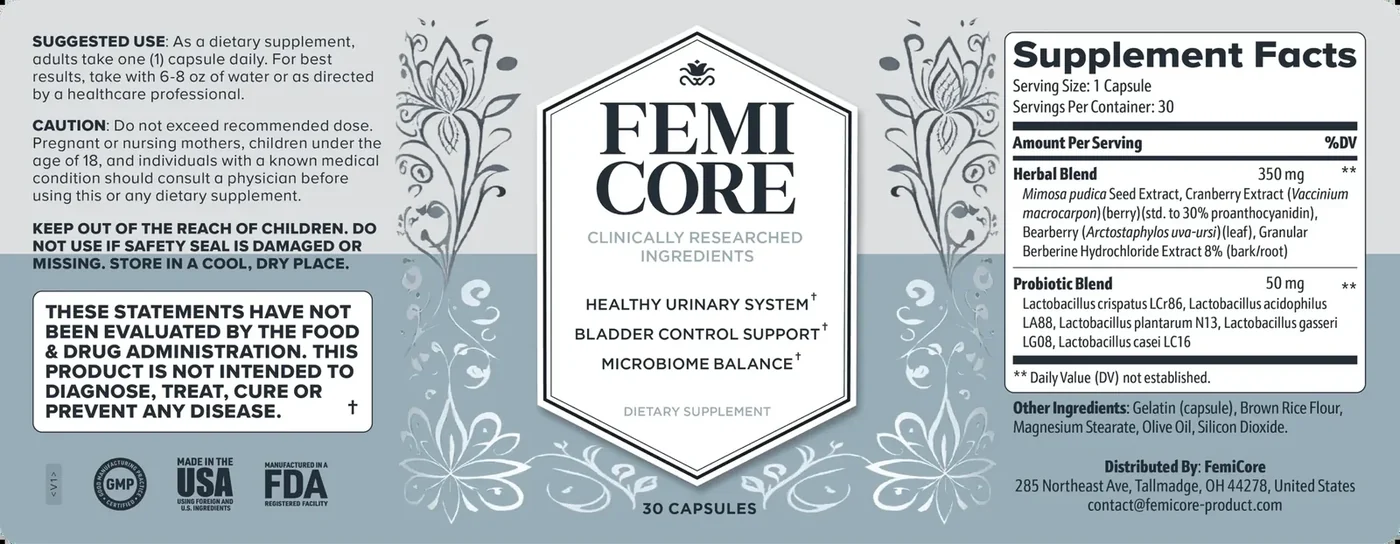
FemiCore lists five named Lactobacillus strains — L. acidophilus, L. casei, L. crispatus, L. gasseri and L. plantarum — alongside its botanicals, and prints its amounts on the Supplement Facts panel reproduced on the sales page. We are not going to tell you that its number is bigger or better than anyone else's, because that is not the point of this article and it would not be an honest claim to make. The point is that you should read that panel with the three questions above in hand: are the strains fully identified, is the count guaranteed through expiry, and is the dose in the range the strain was actually studied at? Those questions apply to every probiotic on the shelf, this one included, and they sit inside the wider 12-point women's supplement label audit.

Check the FemiCore label for yourself
See the Supplement Facts panel, the named strains and the current pricing on the manufacturer's official store, with the 60-day money-back guarantee attached. Read the count and the guarantee point before you decide — that is the whole message of this page.
Order NowWhat the CFU number cannot promise
To be straight about the limits: even a perfectly labelled probiotic — named strains, expiry-guaranteed count, studied dose — is not a cure or a treatment for anything. Probiotics are studied as support for balance, and results are modest, gradual and strain-specific. A big CFU number cannot compensate for the wrong strain, poor storage, or an expectation of overnight change. And no supplement is a substitute for medical care when you have symptoms of an infection.
Medical note: this article is general information, not medical advice. FemiCore is a dietary supplement, not a drug, and is not intended to diagnose, treat, cure or prevent any disease. Speak to a healthcare professional before starting any supplement, especially if you are pregnant, nursing, immunocompromised, under 18, or taking medication.
Related reading
- Prebiotics vs Probiotics: What Women Should Know
- Vitamin D and Recurrent Vaginal Infections: The Evidence
- Normal Vaginal pH Range and Home Testing
Frequently asked questions
What does CFU mean on a probiotic label?
CFU stands for colony-forming units. It is a count of the live bacteria in a dose that are still able to divide and grow a visible colony when cultured in a lab. It is a measure of viable quantity, not of quality, effectiveness or which strains are present. A 10 billion CFU figure tells you how many living cells are in the capsule, and nothing at all about what they do.
Is a higher CFU probiotic always better?
No. Benefit in the clinical literature is tied to a specific strain used at the dose that was actually studied, and that dose is often in the range of 1 to 10 billion CFU rather than the 50 or 100 billion printed on premium labels. Above the studied dose there is usually no added evidence, and doubling the number on the front of the bottle does not double the effect. A large CFU count of an unstudied or poorly matched strain is still an unstudied strain.
Should CFU be guaranteed at manufacture or at expiry?
At expiry. Live bacteria die off gradually through shelf life, so a count that is only guaranteed at the time of manufacture can be substantially lower by the time you swallow the last capsule. A label that says the CFU figure is guaranteed through the end of shelf life, or to the best-by date, is making a more useful promise than one that quietly measures the number on the day it was bottled.
Why does the strain matter more than the CFU number?
Because probiotic effects are strain-specific. Two organisms can share a genus and species, such as Lactobacillus rhamnosus, and still behave differently because they are different strains. Evidence earned by one strain does not transfer to another, and it certainly does not transfer across a whole genus. A full strain designation, the third name or code after the genus and species, is what lets you check whether a strain has been studied at all.
Further reading
- Hill C, Guarner F, Reid G, et al. — Expert consensus document: The International Scientific Association for Probiotics and Prebiotics consensus statement on the scope and appropriate use of the term probiotic, Nature Reviews Gastroenterology & Hepatology 2014;11(8):506–514 (PMID 24912386)
- International Scientific Association for Probiotics and Prebiotics (ISAPP) — consumer guide to probiotics and strain specificity
- NIH Office of Dietary Supplements — Probiotics fact sheet for health professionals
- NIH NCCIH — Probiotics: What You Need To Know
- U.S. FDA — Dietary Supplements overview and labelling requirements
Order FemiCore from the official store
Five named Lactobacillus strains plus cranberry and bearberry botanicals in one daily capsule, with the 60-day money-back guarantee handled by the manufacturer.
Order Now