Vitamin D and Recurrent Vaginal Infections: The Evidence
Quick Answer: Does Vitamin D Help With Recurrent Vaginal Infections?
Observational studies fairly consistently link low vitamin D with recurrent BV and yeast infections, but that is association, not proof. The randomised trials that actually tested supplementation are few, small and mixed. So it is honest to say correcting a real deficiency is worthwhile for general health, but the evidence does not support claiming vitamin D prevents vaginal infections.
- Association: low vitamin D repeatedly seen alongside recurrent BV.
- Causation: not established — RCT evidence is limited and inconsistent.
- Adequacy: serum 25-OH-D of at least 20 ng/mL is considered adequate by NIH.
Vitamin D turns up in almost every women's-health conversation, and recurrent vaginal infections are no exception. You will find confident headlines claiming it prevents bacterial vaginosis (BV) and yeast infections, and equally confident ones saying that is hype — and a third set asking the reverse question, which we answer separately in can vitamin D cause a yeast infection? The truth sits in between, and it is more useful than either. This article separates what the observational data show from what the trials have actually tested, and gives you the general adequacy numbers without promising anything the science has not earned.
What the observational studies show
The starting point is a repeated observation: women with BV, and particularly those with recurrent BV rather than a yeast infection, tend to have lower blood levels of vitamin D than women without it. A 2022 meta-analysis of 14 observational studies in pregnancy put the figure at 54 per cent higher odds of BV with vitamin D deficiency (OR 1.54, 95% CI 1.25–1.91), while a 2026 meta-analysis in non-pregnant women found no overall association at all (pooled OR 1.00). Cross-sectional studies and cohort analyses across different populations have reported this association more often than not, but not consistently. Some studies have found similar patterns for recurrent vulvovaginal candidiasis (the medical name for recurrent yeast infections), though that literature is smaller and less consistent.
Biologically, this is at least plausible. Vitamin D is involved in immune regulation and in the function of epithelial barriers, including mucosal surfaces, and it influences the production of antimicrobial peptides. So there is a coherent story for why low vitamin D might make the vaginal environment more vulnerable to disruption. A plausible mechanism plus a repeated association is enough to justify research interest. It is not enough to justify a prevention claim, and here is why.
Association is not causation — three ways this can mislead
| What we see | The tempting conclusion | The problem |
|---|---|---|
| Low vitamin D in women with recurrent BV | Low D causes BV | Could be reverse or shared cause |
| Both low D and BV common in some groups | Fixing D fixes BV | Confounders (diet, sunlight, general health) travel with both |
| D affects immunity in the lab | Supplementing prevents infection | Lab mechanism does not equal clinical outcome |
These are not hypothetical objections. They are exactly why medicine does not act on associations alone, and why the next section matters more than the last.
What the randomised trials actually found
To know whether raising vitamin D changes anything, you need to give some women vitamin D and others a placebo, then count what happens — a randomised controlled trial (RCT). This is where the confident headlines run out of road. The RCTs testing vitamin D supplementation specifically for preventing recurrent BV or yeast infections are few in number, generally small, and their results are mixed.
Taheri and colleagues, in a placebo-controlled trial of 208 women who were deficient at baseline, reported an asymptomatic-BV cure rate of 63.5 per cent on 2000 IU a day against 19.2 per cent on placebo. Turner and colleagues, giving nine 50,000 IU doses over 24 weeks alongside metronidazole, found no reduction in recurrence at all (hazard ratio 1.11, 95% CI 0.68–1.81). When a body of evidence is this small and this split, the responsible reading is not to pick the favourable trials and quote them — it is to say the question is genuinely unresolved. A 2019-era wave of interest produced several such studies, and subsequent reviews have generally concluded that the evidence is insufficient to recommend vitamin D as a preventive treatment for these conditions.
That is an unsatisfying answer if you were hoping for a simple yes. But it is the accurate one, and it protects you from spending money and hope on a claim the data do not support. The one thing that is well supported: if you are genuinely deficient, correcting that deficiency is worth doing for reasons that have nothing to do with your vaginal microbiome — bone health chief among them.
What this is not. Nothing here is a treatment for an active infection. BV and yeast infections have effective, clinician-directed treatments. If you have symptoms — unusual discharge, odour, itching or burning — the answer is a diagnosis and appropriate care, not a vitamin.
General vitamin D adequacy: the numbers worth knowing
Set the infection question aside for a moment, because vitamin D adequacy matters for every woman regardless. Vitamin D status is measured by a blood test for serum 25-hydroxyvitamin D, written 25-OH-D. The U.S. National Institutes of Health uses these general reference points:
- Deficient: below 12 ng/mL (30 nmol/L)
- Potentially inadequate: 12 to 20 ng/mL (30–50 nmol/L)
- Adequate for most people: at least 20 ng/mL (50 nmol/L)
- Some clinicians target higher: around 30 ng/mL, though this is debated
The recommended dietary allowance for most adults is 600 IU per day (800 IU from age 71), from food, sunlight and supplements combined. The tolerable upper intake level for adults is 4000 IU per day. The crucial point is that these are general-health figures, not vaginal-health prescriptions, and the only way to know where you actually sit is a blood test. Guessing is how people end up either under-treating a real deficiency or over-supplementing toward the upper limit.
Testing before supplementing, and doing it safely
The sensible sequence is test, then treat to target. A confirmed deficiency is usually corrected safely with an appropriate dose of vitamin D guided by your level and your clinician. What is not safe is assuming more is better. Very high long-term intakes can raise blood calcium (hypercalcaemia), which causes real harm, and megadoses have not been shown to deliver extra benefit for the infection question or much else. If you have conditions affecting calcium metabolism, or take medications that interact, this is firmly a conversation for your doctor.
Sunlight and diet matter too. Skin makes vitamin D on sun exposure, though this varies enormously with latitude, season, skin tone and sunscreen use. Dietary sources include oily fish, egg yolks and fortified foods. For many women a modest daily supplement is a reasonable insurance policy through darker months — but that is a general-wellbeing rationale, not a claim about preventing infections.
It is also worth knowing who is most likely to run low, because deficiency is not evenly distributed. Women who get little sun exposure, who have darker skin (melanin reduces vitamin D synthesis), who cover most of their skin, who are older, who carry more body weight, or who have conditions that impair fat absorption are all at higher risk of a low 25-OH-D. Pregnancy and breastfeeding raise demand as well. None of this changes the infection evidence, but it does mean that for a meaningful slice of women, a low result on a blood test is genuinely likely — and in those women, correcting it to an adequate level is a sound, low-risk thing to do for bone and general health, quite apart from any vaginal question. As for form, vitamin D3 (cholecalciferol) is generally preferred over D2 for raising and maintaining blood levels, and it is the form in most supplements.
Where this leaves a women's microbiome supplement
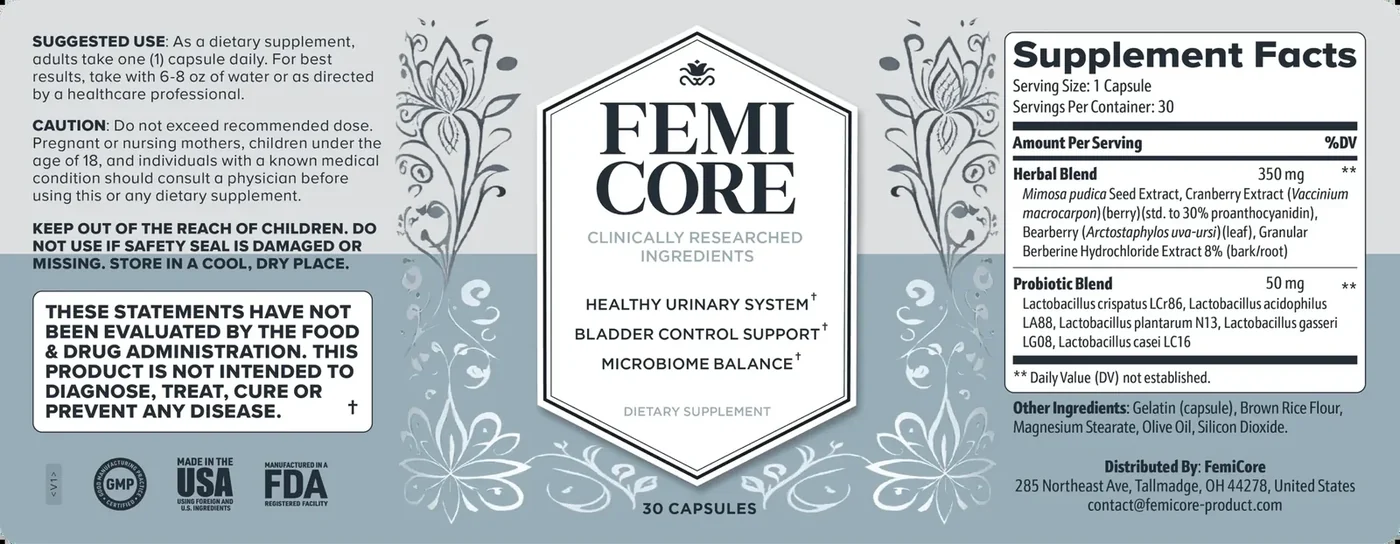
It is worth being clear about what a formula like FemiCore is and is not doing here. FemiCore is built around cranberry and bearberry botanicals, berberine, mimosa pudica and five Lactobacillus strains — its rationale is the microbiome and urinary-comfort side of women's health, not vitamin D repletion. If your specific issue is a suspected vitamin D deficiency, the answer is a blood test and, if warranted, targeted vitamin D, which is a separate product and a separate conversation with your clinician.
The two ideas are not in competition, but they should not be blurred either. Supporting a Lactobacillus-dominant vaginal environment (the probiotic angle — and whether a swallowed capsule reaches it is measurable) and ensuring vitamin D adequacy (the nutrient angle) are different levers on the same broad goal of fewer recurrences over time. We would rather you understood that distinction than assumed one supplement covers both. You can read exactly what is in this formula, with amounts, on our main FemiCore review and on the Supplement Facts panel.
See the FemiCore formula and guarantee
Cranberry and bearberry botanicals with five Lactobacillus strains, on the manufacturer's official store with a 60-day money-back guarantee. A microbiome-and-botanical formula — check the label to see exactly what it does and does not contain.
Order Now
The honest bottom line
Low vitamin D is repeatedly associated with recurrent BV, there is a plausible immune mechanism, and the trials that could confirm cause and effect are too few and too mixed to support a prevention claim. Correcting a genuine deficiency is good for you regardless of your vaginal microbiome, and the way to know if you are deficient is a blood test, not a symptom or a supplement label. That is the whole, unembellished state of the evidence — and it is more useful than a headline promising either a miracle or a myth.
Medical note: this article is general information, not medical advice. FemiCore is a dietary supplement, not a drug, and is not intended to diagnose, treat, cure or prevent any disease. Speak to a healthcare professional before starting any supplement or changing your vitamin D intake, especially if you are pregnant, nursing, under 18, or taking medication.
Related reading
- BV vs Yeast Infection: How to Tell the Difference
- Iron Deficiency and Heavy Periods: A Woman's Guide
- Magnesium for Women: PMS, Cramps and Sleep
Frequently asked questions
Is low vitamin D linked to recurrent BV?
Several observational studies have found that women with bacterial vaginosis, and especially recurrent BV, tend to have lower vitamin D levels than women without it. That is an association, not proof of cause. Low vitamin D may contribute to susceptibility, or it may simply travel alongside other factors. The honest summary is that a link is repeatedly observed, but observation cannot establish that raising vitamin D prevents BV.
Does vitamin D prevent vaginal infections?
The evidence does not support saying that. The observational link is fairly consistent, but the randomised controlled trials that actually tested vitamin D supplementation for preventing recurrent BV or yeast infections are few, small and mixed, with some showing benefit and others none. Until larger, well-designed trials are done, it is inaccurate to claim vitamin D prevents vaginal infections. Correcting a genuine deficiency is worthwhile for general health regardless.
What vitamin D level is considered adequate?
The U.S. National Institutes of Health considers a serum 25-hydroxyvitamin D level of at least 20 nanograms per millilitre (50 nmol/L) adequate for most people's bone and general health, with deficiency defined below 12 ng/mL. Some clinicians aim higher, around 30 ng/mL. The only way to know your level is a blood test, and targets are best interpreted by your own clinician rather than self-diagnosed.
Can supplements fix a vitamin D deficiency safely?
Yes, a confirmed deficiency is usually corrected safely with vitamin D supplementation, but the dose should be guided by your level and your clinician. More is not better: the tolerable upper intake level for adults is 4000 IU per day, and very high long-term doses can raise blood calcium and cause harm. Testing first, then supplementing to target, is safer than guessing with a large dose.
Scientific references
- NIH Office of Dietary Supplements — Vitamin D fact sheet for health professionals (adequacy thresholds and upper limit)
- NIH Office of Dietary Supplements — Vitamin D consumer fact sheet
- U.S. CDC — Bacterial vaginosis overview
- Turner AN, Carr Reese P, Fields KS, et al. — A blinded, randomized controlled trial of high-dose vitamin D supplementation to reduce recurrence of bacterial vaginosis, American Journal of Obstetrics and Gynecology 2014;211(5):479.e1–479.e13 (PMID 24949544)
- Taheri M, Baheiraei A, Foroushani AR, Nikmanesh B, Modarres M — Treatment of vitamin D deficiency is an effective method in the elimination of asymptomatic bacterial vaginosis: a placebo-controlled randomized clinical trial, Indian Journal of Medical Research 2015;141(6):799–806 (PMID 26205023)
- Ma L, Zhang Z, Li L, et al. — Vitamin D deficiency increases the risk of bacterial vaginosis during pregnancy: evidence from a meta-analysis based on observational studies, Frontiers in Nutrition 2022;9:1016592 (PMID 36483925)
- Yang D, Gong X — Association between vitamin D status and bacterial vaginosis in non-pregnant women of reproductive age: a systematic review and meta-analysis, European Journal of Obstetrics, Gynecology and Reproductive Biology 2026;324:115208 (PMID 42235462)
Order FemiCore from the official store
Five named Lactobacillus strains plus cranberry and bearberry botanicals in one daily capsule, with the 60-day money-back guarantee handled by the manufacturer.
Order Now