FemiCore Ingredients: All Nine Label Lines in Order
Quick Answer: What Are the FemiCore Ingredients?
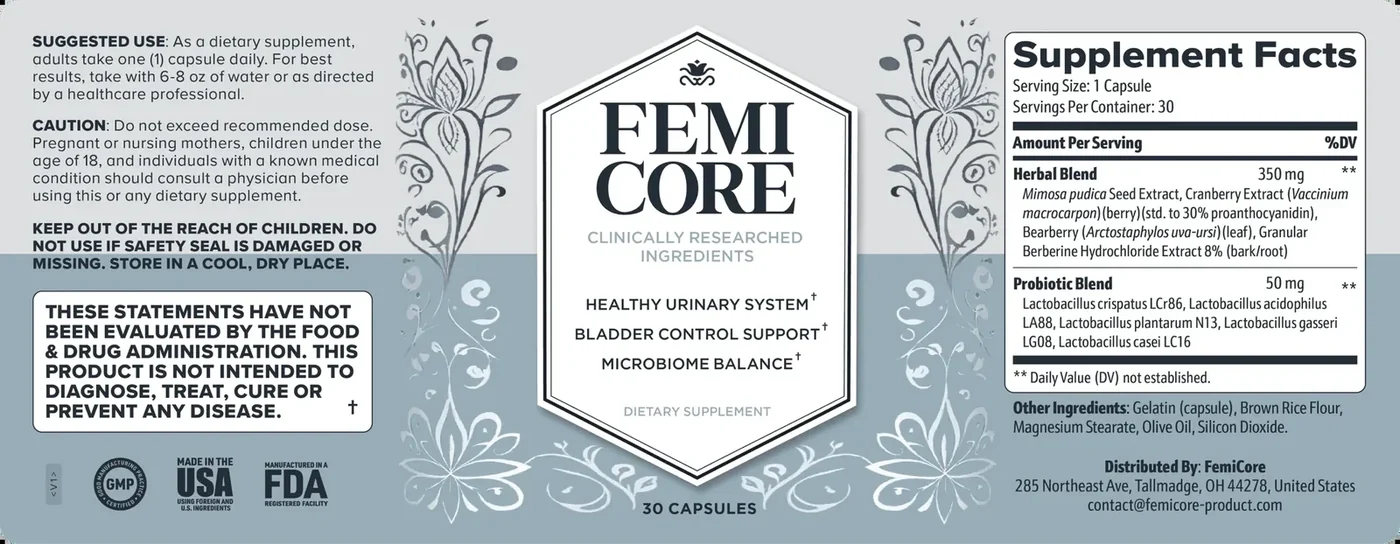
The FemiCore ingredients are mimosa pudica seed extract, cranberry extract standardised to 30% proanthocyanidins, bearberry leaf and granular berberine hydrochloride extract 8% in a 350 mg herbal blend, plus Lactobacillus crispatus LCr86, acidophilus LA88, plantarum N13, gasseri LG08 and casei LC16 in a 50 mg probiotic blend. That is nine named ingredients in one daily capsule.
- Herbal blend, 350 mg: four plant extracts, led by mimosa pudica seed and cranberry.
- Probiotic blend, 50 mg: five named Lactobacillus strains, led by L. crispatus.
- Other ingredients: gelatin capsule, brown rice flour, magnesium stearate, olive oil and silicon dioxide.
Femi Core buyers often ask the same first question: what is actually inside the capsule? The answer is printed on the supplement facts panel, and this guide walks through it line by line, in the order the label lists it. Where the label leaves something out, we say so.
How the FemiCore ingredients label is built
The serving size is one capsule, and each bottle holds 30 servings. The panel splits the formula into two proprietary blends. A proprietary blend lists its ingredients from most to least by weight and prints only the total. So you can see the order and the blend weight, but not how many milligrams of each ingredient you get. The panel also notes that no Daily Value has been established for either blend.
Together the two blends add up to 400 mg of listed ingredients per capsule: 350 mg herbal and 50 mg probiotic. Our label audit guide explains how to read a panel built this way.
The 350 mg herbal blend: four plant ingredients
1. Mimosa pudica seed extract. The first line in the herbal blend. Mimosa pudica seed is a traditional botanical used in gut-focused formulas, and its seed forms a gel-like mucilage in water. It is valued mainly for its long traditional use. Our mimosa pudica evidence check goes deeper.
2. Cranberry extract (Vaccinium macrocarpon), standardised to 30% proanthocyanidins. Proanthocyanidins, or PACs, are the cranberry compounds studied for how bacteria stick to the urinary tract lining. Cranberry is by far the most studied ingredient in this category. The research points to a dose of about 36 mg of PACs a day; because the blend is proprietary, the label cannot show whether this capsule reaches it. See how many mg of cranberry PACs the research uses.
3. Bearberry leaf (Arctostaphylos uva-ursi). Also known as uva-ursi, a traditional European urinary herb whose arbutin content is the usual research focus. Traditional guidance uses it in short courses rather than continuously, which matters if you plan a long run. Read our bearberry duration guide.
4. Granular berberine hydrochloride extract 8% (bark/root). Berberine is a well-researched plant alkaloid, but most of that research looks at metabolic and gut topics rather than the bladder. It can interact with several common medicines, so ask your doctor or pharmacist first. Our berberine interactions guide covers the details.
The 50 mg probiotic blend: five Lactobacillus strains
Each strain carries a code after the species name. That code matters, because probiotic effects belong to a specific strain, not to a species in general.
- Lactobacillus crispatus LCr86: the lead strain. L. crispatus is the species most associated with a stable, Lactobacillus-dominant urogenital microbiome. Our L. crispatus quality check explains what to look for.
- Lactobacillus acidophilus LA88: the most familiar Lactobacillus, common in general probiotic blends.
- Lactobacillus plantarum N13: a well-characterised species known for good survival through digestion.
- Lactobacillus gasseri LG08: a species often found alongside L. crispatus in the vaginal microbiome.
- Lactobacillus casei LC16: a long-established species with a broad research base in digestive health.
The label prints no CFU count. CFU means colony-forming units, the number of live cells, and a weight in milligrams cannot show it. Our guide on why a bigger CFU count is not always better puts that in context.
Other ingredients and what they mean for you
The non-active ingredients are gelatin (the capsule), brown rice flour, magnesium stearate, olive oil and silicon dioxide. These help fill and protect the capsule. The gelatin shell means FemiCore is not vegetarian or vegan. The seller lists the formula as non-GMO with no stimulants, and the label carries GMP and made-in-the-USA marks, with a named distributor in Tallmadge, Ohio.
How the ingredients work together
The formula pairs two ideas in one capsule. The herbal side brings the traditional urinary botanicals, cranberry and bearberry, with berberine and mimosa pudica alongside. The probiotic side supplies five Lactobacillus strains aimed at urinary microbiome balance. The label states three goals for the formula: a healthy urinary system, bladder control support and microbiome balance.
The ingredient research is real, but it belongs to the ingredients, not to the finished capsule, which has not had its own clinical trial. Cranberry studies measured results over 12 to 24 weeks of daily use, so the ingredients are best judged over a steady routine, not a few days.
How to take FemiCore and who should check first
The label directs adults to take one capsule a day with 6 to 8 ounces of water. Do not exceed that dose. Pregnant or nursing women, anyone under 18 and anyone with a known medical condition should consult a physician first. Because of the berberine and bearberry, people on prescription medicine should ask before starting. Burning when you urinate, fever, blood in the urine or back pain need a doctor, not a supplement.
If the label looks right for you, compare the packs in our FemiCore price guide and read what buyers report in FemiCore reviews.
Related reading
- FemiCore ingredients overview
- Cranberry and Lactobacillus: Women's Urinary Health Evidence
- Prebiotics vs Probiotics for Women's Health
Frequently asked questions
How many ingredients are in FemiCore?
FemiCore has nine named ingredients: four plant extracts in a 350 mg herbal blend and five Lactobacillus strains in a 50 mg probiotic blend. The capsule shell and fillers are listed separately as other ingredients.
Does the FemiCore label show the amount of each ingredient?
No. Both blends are proprietary, so the label prints the 350 mg and 50 mg totals and the order of ingredients, but not single amounts. No CFU count is printed for the probiotic strains.
Is FemiCore vegetarian?
No. The capsule shell is gelatin, so FemiCore is not vegetarian or vegan. The other ingredients are brown rice flour, magnesium stearate, olive oil and silicon dioxide.
What is the probiotic in FemiCore?
FemiCore has a 50 mg probiotic blend of five Lactobacillus strains: crispatus LCr86, acidophilus LA88, plantarum N13, gasseri LG08 and casei LC16.
Nine named ingredients, one capsule a day
FemiCore pairs four botanicals with five Lactobacillus strains. Order on the official website, from $49 a bottle, with the 60-day money-back guarantee.
Order Now